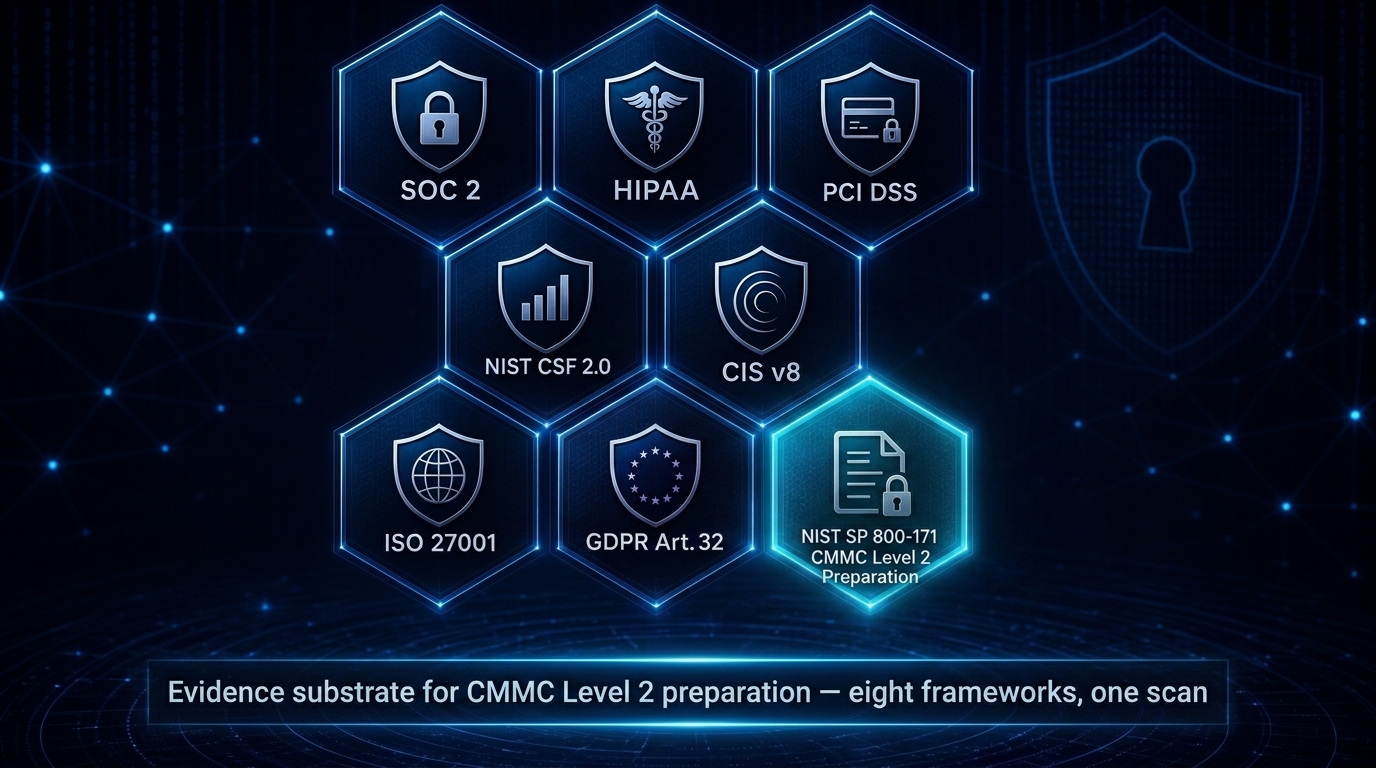
GDPR Article 32 substrate the supervisory authority actually reads.
NSAuditor AI EE produces an Article 32 (Security of Processing) infrastructure-substrate pre-audit report mapped per-sub-measure to Regulation (EU) 2016/679, Article 32. SHA-256 chain-of-custody sidecars, cover-page Scope Attestation, four-factor proportionality discipline, Art. 83(4) lower-tier fine framing — and Zero Data Exfiltration: no scan data or evidence artifact is ever transmitted to Nsasoft, and the egress register that ships in the Enterprise package (utils/egress_register.mjs) enumerates 18 outbound paths, each with its trigger and its default. This is Art. 32 substrate only: it is not GDPR compliance, and no GDPR certificate exists under the Regulation.
✓ 4 sub-measures covered⚠ 5 partial⊘ 2 OOS-by-design⚡ Art. 32 substrate ONLYLatest: EE 1.3.0 (2026-10-07) — a finding on a port, region or producer a scan did not measure is not counted as fixed — two measured limits stated. Requires CE ≥ 0.2.57.
LATEST · EE 1.3.0 · 2026-10-07GDPR Article 32 (Security of Processing)
EE 1.3.0 (2026-10-07) is the current release — a finding on a port, region or producer a scan did not measure is not counted as fixed — two measured limits stated. The two limits, measured and stated rather than hidden: a scan made before EE 1.3.0 could not record a plugin left out of it, so in a comparison with one, an agent’s row that scan lacks is not refused — the report’s Basis cell says so on the row; and a scan that discovered ports with the Nmap plugin (024) alone records no port oracle, so an analysis agent’s or the CVE mapper’s row on a port it did not measure can read RESOLVED and count as closed in MTTR, and the control it failed can read PASS — include the port scanner (003). What 1.3.0 changes for GDPR Article 32: SLA age and time to remediate no longer reset on every scan — since EE 0.32.4 the GDPR Article 32 pack stored its findings’ prose with other frameworks’ control ids removed, and MTTR read an earlier scan from that stored text, so most cloud findings, whose prose names SOC 2 criteria, were counted as closed on each later scan and as newly found, and their age never reached an SLA threshold; a finding is now keyed on its prose with every framework’s ids removed, on both sides, so a history written by any earlier release reads correctly with no pack regenerated; and the CVE mapper’s record of a lookup that itself failed now fails Art.32(1)(d)-testing-effectiveness, the sub-measure a CVE row maps to, as an evidence gap, inside the existing enumeration. Coverage: all eight coverage matrices unchanged since EE 1.2.0. Per-release history lives in the package CHANGELOG.md; this page describes the GDPR Article 32 mapping as it ships today.
NSAuditor AI EE generates technical-substrate evidence for GDPR Article 32 (security of processing) — and ONLY for the infrastructure facets of that single article.
It maps cloud infrastructure findings (AWS, Azure, GCP) and network scan results to specific Art. 32 sub-measures (Art.32(1)(a)-encryption-at-rest, Art.32(1)(b)-confidentiality, Art.32(1)(c)-restore-capability, …), produces hash-chained evidence artifacts (cover-page Scope Attestation, SHA-256 chain-of-custody sidecars, and a documented suppression workflow — the same institutional-grade pipeline shipped for SOC 2 + HIPAA + NIST CSF 2.0 + PCI DSS + ISO 27001 + CIS v8), and emits machine-readable reports suitable for privacy-GRC ingestion.
The scoping doctrine — the most important paragraph on this page: The tool claims GDPR Article 32 infrastructure substrate and nothing more. Regulation (EU) 2016/679 is a 99-article legal regime. Article 32 (security of processing) is the only article whose evidence is technical infrastructure state; every other article is operator-side legal/process discipline, out of scope by design. This report is input to your Article 32 measures — it is not GDPR compliance, not a GDPR certificate (no such certificate exists under the Regulation), and not a substitute for any operator-side obligation.
It is not:
Whole-Regulation coverage. GDPR has 99 articles. This evidences the infrastructure facets of Art. 32 only. Lawful basis (Art. 6), consent (Art. 7), data-subject rights (Arts. 12–23), records of processing (Art. 30), breach notification (Arts. 33–34), DPIA (Art. 35), DPO (Arts. 37–39), and international transfers (Arts. 44–49) are all operator-side and OOS-by-design.
A personal-data classifier. The scanner reads encryption / access / availability state — it cannot determine which resources actually hold personal data. Every finding is an Art. 32 concern only if the resource processes personal data (see Personal-Data-Scope Attestation). Pair with your Art. 30 RoPA.
An absolute pass/fail verdict. Art. 32(1) measures are explicitly proportionate — "appropriate to the risk" (see the four-factor section). The engine produces substrate FOR the operator's appropriateness determination; it does not make that determination.
A risk-assessment (Art. 32(2)). The risk-assessment process is operator-side and OOS — the GDPR analog of HIPAA §164.308(a)(1)(ii)(A) Risk Analysis. The engine produces inputs to it; it cannot perform it.
A fine-exposure calculator. Art. 32 infringements sit in the lower Art. 83(4) tier (see below). Overstating fine exposure is itself an overclaim.
What it IS: the technical-substrate evidence layer for the Art. 32 sub-measures where cloud-infrastructure scanning can deterministically read the configuration state (encryption, access control, public exposure, availability protections, backup mechanisms, logging, IAM scoping). Every covered + partial sub-measure carries a stable controlObjective, proportionalityFactors, personalDataScope attestation, art83Tier, supervisoryAuthorityNote, and cloudProviderAttestation in data/compliance/gdpr.json.
The market split: privacy-GRC platforms (OneTrust, TrustArc, DataGrail) automate the records-of-processing / DSAR / consent / DPIA / breach-register workflow but lack deep cloud-infrastructure scanning; legacy scanners produce voluminous CVE reports but don't map findings to Art. 32 sub-measures. NSAuditor's wedge is the bridge — deep scanning + per-sub-measure-mapped Art. 32 substrate + the same Zero Data Exfiltration architecture used for the other seven frameworks. Neither tool, standalone, is GDPR coverage — and this page never claims the engine is.
The four-factor proportionality discipline — nothing here is absolute pass/fail
Article 32(1) requires the controller and processor to implement "appropriate technical and organisational measures to ensure a level of security appropriate to the risk." The chapeau of Art. 32(1) names four factors the appropriateness determination must weigh:
Factor
What it means
Engine's role
State of the art
The current technical baseline (e.g., TLS 1.2+, modern KMS-managed encryption)
Engine reads whether the substrate meets the current baseline (sub-TLS1.2, missing SSE)
Costs of implementation
The cost of a measure weighed against the risk it mitigates
Operator-side judgment — the engine cannot weigh cost
Nature, scope, context & purposes of processing
What data, how much, why, in what context
Operator-side — the engine does not know the processing purpose
Risk to the rights and freedoms of natural persons
Likelihood + severity of harm to data subjects
Operator-side risk determination, informed by engine substrate
The discipline: NOTHING the engine produces is an absolute pass/fail. A single-AZ database, a Microsoft-managed (vs customer-managed) key, an unencrypted store — each is substrate for the operator's "appropriate to the risk" determination, not a verdict. Appropriateness for special-category (Art. 9) data differs from appropriateness for low-sensitivity data. Each sub-measure in gdpr.json carries a proportionalityFactors array recording which of the four factors it most directly bears on (e.g., encryption → state-of-the-art + risk; availability → nature-scope-context-purposes + cost-of-implementation).
The engine emits substrate; the operator owns the proportionality call.
Personal-data-scope attestation — the scanner cannot know what holds personal data
Article 32 applies to the security of processing of personal data. The scanner reads infrastructure state (encryption enabled? public access? SSL enforced?) — it cannot determine which resources actually contain personal data. The consequences:
An unencrypted S3 bucket is an Art. 32 finding only if it holds personal data. A public bucket of marketing assets is not an Art. 32 violation.
An unencrypted transport channel is an Art. 32 concern only if it carries personal data. An HTTP endpoint serving only public static assets is not.
A confidentiality / public-exposure finding is an Art. 32 concern only if the over-exposed resource processes personal data.
Every covered and partial sub-measure in gdpr.json carries a personalDataScope field stating exactly this caveat. Pair every finding with your Article 30 Records of Processing Activities (RoPA) to confirm the resource is in-scope for personal-data processing before treating an engine finding as an Art. 32 violation. The Art. 30 RoPA is the GDPR analog of the HIPAA ePHI-scope determination and the PCI DSS Cardholder Data Environment (CDE) scope tag: the substrate is only a finding where the data is in scope.
Controller vs processor role applicability + the Art. 28 processor agreement (DPA)
Article 32 binds both controllers and processors ("the controller and the processor shall implement…"). Every sub-measure in gdpr.json carries roleApplicability: "both" — the substrate is relevant regardless of which role the operator occupies for a given processing activity.
Controllers determine the purposes and means of processing and own the overall appropriateness determination.
Processors process on the controller's documented instructions and must provide sufficient guarantees of appropriate Art. 32 measures (Art. 28(1)). The engine's substrate is the kind of "sufficient guarantee" evidence a processor supplies to a controller's vendor-assessment.
The Art. 28 processor agreement (Data Processing Agreement / DPA) is the contractual instrument documenting the instruction boundary. It is operator-side — the engine does not produce it. It is, however, the organisational complement to the Art.32(4)-instruction-bound-processing sub-measure: the engine's IAM least-privilege substrate technically enforces the instruction boundary that the Art. 28 DPA contractually documents. Neither half alone satisfies Art. 32(4).
Art. 83(4) fine-tier discipline — Art. 32 sits in the LOWER tier
Overstating fine exposure is itself an overclaim. Article 32 infringements fall under the Art. 83(4) administrative-fine tier:
Tier
Cap
What falls here
Art. 83(4) — LOWER
up to €10 million OR 2% of total worldwide annual turnover (whichever higher)
Article 32 (security of processing) + controller/processor obligations under Arts. 8, 11, 25–39, 42–43
Art. 83(5) — HIGHER (headline)
up to €20 million OR 4% of total worldwide annual turnover (whichever higher)
Basic principles (Arts. 5, 6, 7, 9), data-subject rights (Arts. 12–22), international transfers (Arts. 44–49) — NOT Art. 32
The famous "€20M / 4%" headline figure is the Art. 83(5) tier and does not apply to Art. 32 security-of-processing infringements. Every sub-measure in gdpr.json carries art83Tier: "83(4)-lower". When framing fine exposure from an Art. 32 finding, the correct ceiling is €10M / 2%, not the headline number. (Note: an underlying security failure can still draw an Art. 5(1)(f) "integrity and confidentiality" principle charge, which is Art. 83(5) tier — but that is an operator-side legal determination, not something the engine asserts from an Art. 32 substrate finding.)
Source of truth is data/compliance/gdpr.json; this matrix mirrors it. Per-sub-measure (Art. 32(1)(a)–(d) + 32(2) + 32(4)) is the supervisory-authority-canonical citation unit — never the paragraph level. Every GDPR (source, titlePattern) pair inherits from the grep-verified soc2.json pattern set per the inheritance contract.
⚠ Partial — the recurring scan is ONE input; operator pen-testing + DR drills + documented test-evaluate-remediate process complete it
instruction-bound-processing
32(4)
Persons under authority process only on instructions
IAM least-privilege, no privilege-escalation, no over-broad effective decrypt
⚠ Partial — IAM scoping is the technical half; the Art. 28 processor agreement + documented instructions + confidentiality undertakings are operator-side
pseudonymisation
32(1)(a)
Pseudonymisation of personal data
—
⚪ OOS-by-design — a data-model decision wholly outside the scanner's visibility; the encryption siblings are adjacent 32(1)(a) measures but credit nothing here. Operator attests per the data model
risk-assessment
32(2)
Account for the risks presented by processing
—
⚪ OOS-by-design — an operator-side risk-assessment process (GDPR analog of HIPAA §164.308(a)(1)(ii)(A) Risk Analysis). The engine produces substrate that INFORMS it; it cannot perform it
Totals: 4 covered + 5 partial + 2 OOS = 11.
Why the two OOS units are OOS and not partial
Art. 32(1)(a) pseudonymisation: Art. 32(1)(a) names BOTH pseudonymisation AND encryption. Encryption is substrate-rich (the two covered facets above); pseudonymisation is a data-model decision the scanner cannot see. Classified OOS rather than partial because a unit whose every available signal credits nothing toward it is OOS in substance — "partial" would falsely imply the engine partially evidences pseudonymisation when it evidences none. The encryption siblings are distinct measures in the same sub-paragraph and are never conflated with it.
Art. 32(2) risk-assessment: An operator-side process obligation, not infrastructure state. The engine produces configuration state, vulnerability findings, and IAM-exposure substrate that INFORM the assessment, but it cannot perform the assessment. Pair with the operator's DPIA process per Art. 35 where applicable + a privacy-GRC platform (OneTrust / TrustArc / DataGrail).
Per-sub-measure substrate walk
For each covered + partial sub-measure below, the engine produces findings the DPO / supervisory authority can attach to the Art. 32 sub-measure with a stable, supervisory-authority-grounded rationale. Patterns inherited from soc2.json's grep-verified pattern set. Evidence-gap anchors fail-close (un-enumerated region, AccessDenied, scan-time-budget exceeded) — never a false-clean.
Art. 32(1)(a) — encryption-at-rest ✓ Covered
Render personal data at rest unintelligible to unauthorised parties. Substrate: S3 server-side-encryption state; customer-managed KMS key rotation; Azure storage keySource (Microsoft-managed vs customer-managed); unresolvable-CMK detection; infrastructure double-encryption. Evidence-gap anchors fail-close (un-enumerated KMS region, missing Azure keySource property, scan-time-budget exceeded). DPA context: missing encryption-at-rest over personal data is a recurring breach-investigation finding (the British Airways / Marriott class of Art. 32 / Art. 5(1)(f) failures).
Art. 32(1)(a) — encryption-in-transit ✓ Covered
Protect personal data on the wire via enforced TLS. Substrate: RDS SSL-enforcement; Azure plaintext-HTTP (enableHttpsTrafficOnly=false); Azure minimum-TLS below the TLS1_2 baseline; weak-cipher detection via crypto_agent. Evidence-gap anchors fail-close (missing Azure HTTPS-only / minimum-TLS property; un-enumerated region). State-of-the-art (TLS 1.2+) is the baseline expectation in DPA reasoning.
Art. 32(1)(b) — confidentiality ✓ Covered
Ensure only authorised parties access personal data. Substrate: IAM shadow-admin paths; missing MFA; S3 policy-granted public access + confirmed public accessibility; anonymous public blob access (Azure); broad key-vault role grants; all-protocol 0.0.0.0/0 ingress (AWS SG + GCP firewall). Over-broad KMS decrypt grants and anonymous SQS/SNS read grants also route to Art. 32(1)(b)-confidentiality as substrate findings (the matrix stays 4 / 5 / 2; send/delete-only grants are not confidentiality concerns). Evidence-gap anchors fail-close (S3 object-ACL AccessDenied; Azure account/container enumeration incomplete). Unauthorised-access / public-exposure is the single most common breach root cause in DPA enforcement decisions.
Art. 32(1)(b) — availability ✓ Covered
Keep personal data available against accidental loss. Substrate: Azure blob soft-delete / versioning state; AWS logically air-gapped backup vaults. Evidence-gap anchors fail-close (Azure blob-service-properties unreadable; un-enumerated AWS Backup region; truncated enumeration). Accidental destruction / loss is named explicitly in Art. 32(2) as a risk to guard against; soft-delete / versioning / backup are the appropriate-to-risk availability measures.
Art. 32(1)(b) — integrity ⚠ Partial
Detect and evidence unauthorised alteration. Substrate: CloudTrail trail presence; Key Vault AuditEvent diagnostic-export. Partial because audit-trail substrate is necessary integrity-monitoring evidence but not sufficient; the operator's change-detection review, immutability (object-lock/WORM), and tamper-investigation process complete the determination. DPA context: absent/unmonitored audit trails leave alteration of personal data undetectable.
Art. 32(1)(b) — resilience ⚠ Partial
Withstand and recover from faults via redundancy. Substrate: RDS single-AZ (MultiAZ=false) detection. Partial because redundancy configuration is necessary substrate but not sufficient; the operator's DR drills, multi-region failover testing, and documented continuity process complete it. Whether single-AZ is appropriate depends on the cost of redundancy weighed against the nature/purposes of processing (Art. 32(1) chapeau).
Art. 32(1)(c) — restore-capability ⚠ Partial
Restore availability + access in a timely manner after an incident. Substrate: DynamoDB PITR; air-gapped backup vaults; S3 lifecycle/retention. Partial because the engine evidences the restore MECHANISM, but Art. 32(1)(c) requires restore-ABILITY, which only a successful, periodic restore TEST establishes. Backup existence is necessary but not sufficient: an untested or co-located/ransomware-encrypted backup does not satisfy (c). Art. 32(1)(c) is the ransomware-resilience article — air-gapped/immutable vaults and PITR are the appropriate-to-risk restore substrate; the operator owns restore-test cadence.
Art. 32(1)(d) — testing-effectiveness ⚠ Partial
A process for regularly testing/evaluating measure effectiveness. Substrate: GuardDuty enablement; CVE surfacing via intelligence_engine; end-of-life software detection. Partial because this recurring scan + vulnerability/threat-detection substrate is ONE input to the Art. 32(1)(d) regular-testing process; it is NOT the whole. The operator's penetration testing, DR drills, and documented test-evaluate-remediate process complete the obligation — the engine must not claim it IS the operator's regular testing. Art. 32(1)(d) is a PROCESS obligation: DPAs look for evidence of regular, documented testing + remediation, not a one-time snapshot.
Persons under authority process personal data only on instructions. Substrate: IAM privilege-escalation paths; PassRole shadow-admin paths; effective kms:Decrypt on Resource:*. Partial because IAM least-privilege scoping enforces the boundary technically, but the organisational half (the Art. 28 processor agreement, documented processing instructions, personnel confidentiality undertakings) is operator-side. A person able to escalate privilege or decrypt at will can process personal data beyond instructions.
Art. 32(3) / Art. 42 certification-inheritance — provider adherence as a demonstrable-compliance ELEMENT
Article 32(3) provides that adherence to an approved code of conduct (Art. 40) or an approved certification mechanism (Art. 42) may be used as an element by which to demonstrate compliance with the Art. 32 requirements. For provider-controlled substrate (the physical and lower-stack layers of the shared-responsibility model), the cloud provider's third-party attestations are exactly such an element.
Each sub-measure in gdpr.json carries a cloudProviderAttestation block referencing, per provider:
Provider
Adherence referenced as a demonstrable-compliance element
AWS
ISO/IEC 27001 + SOC 2 + C5 (BSI) + EU Cloud Code of Conduct (Art. 40)
Microsoft Azure
ISO/IEC 27001 + SOC 2 + C5 (BSI) + EU Cloud Code of Conduct (Art. 40)
Google Cloud
ISO/IEC 27001 + SOC 2 + C5 (BSI) + EU Cloud Code of Conduct (Art. 40)
Two disciplines apply:
An element, NOT a substitute. Provider adherence is a demonstrable-compliance element for provider-controlled substrate only. It does not substitute for the operator's own appropriate measures over operator-controlled configuration (the encryption, access, and IAM choices this engine reads). The provider's C5/ISO/SOC posture does not make an operator's public bucket compliant.
Annual currency. Provider attestations are time-bounded — verify current scope + validity per service. Re-pull the current attestation at every EE release cycle and at every annual privacy-program review.
Rest-of-GDPR — OOS-by-design
Article 32 is one of 99 articles. The rest of the Regulation is operator-side legal/process discipline, OOS-by-design for any infrastructure scanner. Pair each with the named operator-side instrument:
Article(s)
Obligation
Why OOS
Operator-side pairing
Art. 6
Lawfulness of processing (lawful basis)
A legal-basis determination, not infrastructure state
This is the GDPR analog of the ISO 27001 ISMS-Clauses-4–10 OOS framing and the NIST CSF Govern-function OOS framing: the engine evidences the technical substrate; the legal/process/governance scaffolding is operator-side.
How to run an Art. 32 scan
Once the EE package is installed and your license is activated, every scan can emit GDPR Article 32 substrate by passing --compliance gdpr. The CLI's --compliance flag accepts CSV — the same finding stream feeds every framework engine in a single scan, so no re-scan is needed to add Art. 32 substrate to an existing multi-framework workflow.
A report you can send, since EE 0.44.0 (Pro and Enterprise).nsauditor-ai report --from <out-dir> --format executive renders a finished scan as one self-contained, print-ready HTML file that opens with no external network reference — nothing is fetched from a vendor when your DPO or a supervisory authority opens it, which keeps the artifact inside the same boundary the scan ran in. --brand adds optional cover-page branding; --format jira writes a Jira-importer CSV whose field mapping is completed inside Jira and is not verified against a live instance. The report states what it could not read: finding-like records sitting in a container the report does not open are named and counted on the page, so an Art. 32(1)(d) reviewer sees the boundary of the evidence rather than inferring it from an absence.
Each --compliance gdpr run writes a per-sub-measure Art. 32 report (cover-page Scope Attestation, per-sub-measure status with Art. 32 rule-text citations + proportionality factors + personal-data-scope caveat + Art. 83(4) tier note), plus the machine-readable JSON suitable for privacy-GRC ingestion. All artifacts ship with a .sha256 integrity sidecar and can run side-by-side with the other seven framework packs.
Zero Data Exfiltration — no new processor under Art. 28
NSAuditor AI EE inherits the same Zero Data Exfiltration architecture across all eight supported frameworks:
Local-only scanning — no scan data leaves the operator's environment; no SaaS dependency.
Local-only AI — Claude API integration is OPTIONAL (operator-configured); air-gapped fallback for restricted-data scope.
Operator-controlled signing — suppression approval and scope attestation operator-side.
This architecture is institutionally critical under GDPR because a SaaS compliance tool that ingests scan data into a third-party cloud environment introduces a new processor (Art. 28) — and, where personal data is involved, a new processing activity that the operator's RoPA (Art. 30) and DPA chain must address, plus a potential international-transfer (Arts. 44–49) consideration if that processor operates outside the EEA. Zero Data Exfiltration sidesteps that processor expansion entirely — the scan substrate never becomes someone else's processing operation.
Auditor / DPA FAQ
Is this GDPR compliance? (No — Article 32 substrate only.)
No. This is NOT GDPR compliance and there is no GDPR certificate under the Regulation. NSAuditor produces infrastructure-substrate evidence for the technical facets of Article 32 only — one article of a 99-article legal regime. Every other article is operator-side and OOS-by-design. This report is input to your Art. 32 measures, not a whole-of-Regulation attestation.
Is an unencrypted bucket automatically an Article 32 violation?
No. Art. 32 applies to the security of processing of personal data. The scanner reads infrastructure state but cannot determine which resources actually hold personal data. An unencrypted bucket is an Art. 32 finding only if it holds personal data. Pair every finding with your Art. 30 RoPA to confirm the resource is in-scope first.
What fine tier do Article 32 infringements fall under?
The lower Art. 83(4) tier — up to €10 million OR 2% of total worldwide annual turnover, whichever is higher. The famous €20M / 4% headline is the Art. 83(5) HIGHER tier (basic principles, data-subject rights, international transfers) and does not apply to Art. 32. Quoting the headline number against an Art. 32 finding is itself an overclaim.
Is the engine an absolute pass/fail verdict for Article 32?
No. Art. 32(1) measures are explicitly proportionate — "appropriate to the risk." The chapeau names four factors (state of the art, cost of implementation, nature/scope/context/purposes, risk to data subjects) the operator must weigh. The engine produces substrate FOR that appropriateness determination; it does not make it.
Can NSAuditor perform the Art. 32(2) risk assessment?
No. Art. 32(2) is an operator-side risk-assessment process — the GDPR analog of the HIPAA §164.308(a)(1)(ii)(A) Risk Analysis. The engine produces substrate that INFORMS it; it cannot perform it. Pair with your DPIA process (Art. 35) and a privacy-GRC platform (OneTrust / TrustArc / DataGrail).
How does cloud-provider ISO 27001 / SOC 2 / C5 adherence count?
Art. 32(3) allows adherence to an approved code of conduct (Art. 40) or certification mechanism (Art. 42) to be used as an element to demonstrate compliance — not a substitute. It applies to provider-controlled substrate only and does not make the operator's public bucket compliant. Attestations are annual-currency: re-verify scope and validity each release cycle.
Why is pseudonymisation out of scope when Art. 32(1)(a) names it?
Art. 32(1)(a) names BOTH pseudonymisation and encryption. Encryption is substrate-rich (the two covered facets); pseudonymisation is a data-model decision the scanner cannot see. A unit whose every available signal credits nothing toward it is OOS in substance — calling it "partial" would falsely imply partial evidence where there is none. The encryption siblings are distinct measures in the same sub-paragraph and are never conflated with it.
Does this replace OneTrust / TrustArc / DataGrail?
No — it complements them. NSAuditor handles the Art. 32 technical-substrate dimension (per-sub-measure configuration evidence + SHA-256 chain-of-custody); the privacy-GRC platform handles RoPA + DSARs + consent + DPIA + breach register + the rest of the 99 articles. NSAuditor + a privacy-GRC platform = a complete Article 32 program inside a complete GDPR program. Neither tool, standalone, is GDPR coverage.